Last modified: 2026-10-31 by rob raeside
Keywords: colombia | air force |
Links: FOTW homepage |
search |
disclaimer and copyright |
write us |
mirrors
See also:
 based on image
Alternate depiction:
 image by Željko Heimer, 23 May 2001
 image by Eugene Ipavec, 13 December 2005
Low-visibility version
According to [pay00] -
Aircraft Marking - A note to the figure explains that the
national flag is painted on the fin as Fin Flash.
The marking is a roundel divided horizontally and lower part
again vertically in yellow, blue and red and in the center
covered with a disk divided horizontally in red, blue and yellow
(yellow covering the whole lower half), and over it in the middle
a white star. The star is a five-pointed star in Album 2000. In
Album 1995 the star is of eight points, and as far as I have
observed - ight-pointed star is preffered star shape throughout
the Colombian history - so I am inclined to believe that the
five-pointed star in Album 2000 might be an error. Other source
by hand is [zna99] with
eight-pointed star also.
Željko Heimer, 23 May 2001
According to Cochrane - military aircraft insignia [cos98], the star was changed to 5
points in 1953. Wheeler Aircraft Markings [whe86] also gives 5 points in 1986.
Armand du Payrat, 25 May 2001
A government decree no. 126 of 31 December 1919 to form aviation element of
Army was the first step for the establishement of Fuerza Aérea Colombiana. On 4
April 1922 Aviacion Militar was formed and it was renamed in 1943 Fuerza Aérea
Nacional and renamrd again in 1947 to its current name. Homepage at www.fac.mil.co
.
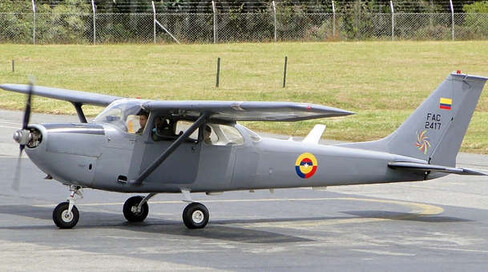
According to [cos98], since 1925 the FAC use
its complicated roundel, and the only change was in 1953 when the star was
changed to 5 points star and instead of a roundel as fin flash, came rudder
stripes. See: www.skytamer.com
(1925-1953) and www.skytamer.com
(post 1953). Jane's 1945 report 8 points star and national colors
as rudder stripes. [whe86] report a 5 points
star an a sqare fin flash. www.aeroflight.co.uk
also report 5 points. Photo at www.airliners.net/240294
show clearly a 5 points star as well www.airliners.net/240293
. Unfortunally, old photos are so unclesr and the star so small, so I can't have
a good one. We shall have to trust the books on this. The rudder stripes are
used on uncamoflagued planes. Combat planes carry a small flag as fin flash (see www.scramble.nl).
Dov Gutterman, 14 June 2004
The low-visibility version differs somewhat in layout from the
regular roundel, too - the inner ring is a bit larger, and the
cental star noticeably smaller.
Source: photo at www.fac.mil.co,
reported by E.R.
Eugene Ipavec, 13 December 2005
There are several roundels used throughout the years, as seen on the FAC official website (All of the roundels that featured on this website and the explanation of them are extracted from the book: "75 Años en los Cielos Patrios", published by Editorial Margabby Ltd., First edition in 1994, by FAC Lt. Col. (r) Oscar Forero Racines):
First roundel (1920-1924)
 image by Nozomi Kariyasu, 7 May 2024
Based on: image
Second roundel and fin flash (1924-1927)
 image by Nozomi Kariyasu, 7 May 2024
Based on: image
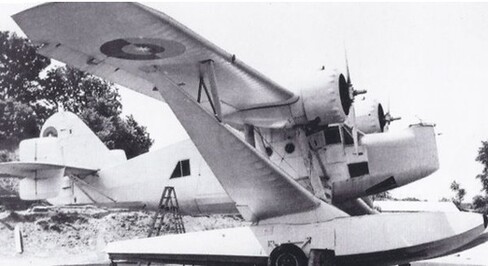
Third roundel and fin flash (1927-1953)
 image by
Nozomi Kariyasu, 7 May 2024
Based on: image
The third roundel is regulated by
Decree 289 of February 21, 1927. The
official description is as follows (original in Spanish):
"Article 1. The following insignia are adopted for both military and commercial aircraft in the country: For military aircraft the signal will be a flag with the national colors, in the
following form: A circle whose diameter must be equal to 4/5 parts of the depth of the wing and located 4/5 parts of the width of the same wing.
A second circle concentric to the first and whose radius is equal to half the radius of the first. The first circle will be divided into two equal parts by a horizontal diameter; the upper part
will be painted yellow, the lower part will be divided into two equal parts by a vertical radius, of which the left part will be painted blue and the right part red. The second circle will be equally
divided into two parts, also by a horizontal diameter; The upper part of this division will be painted with the colors red and blue horizontally, and on the yellow background of the first circle;
the bottom will be painted yellow over the blue and red colors of the first circle. Finally, within this second circle there will be a white nine-pointed star, like the one worn by our commercial
National Pavilion; said star will be the size of a quarter of the main circle."
Esteban Rivera, 9 June 2025
Third roundel (1927-1953) (alternate)
 image by Željko Heimer, 23 May 2001
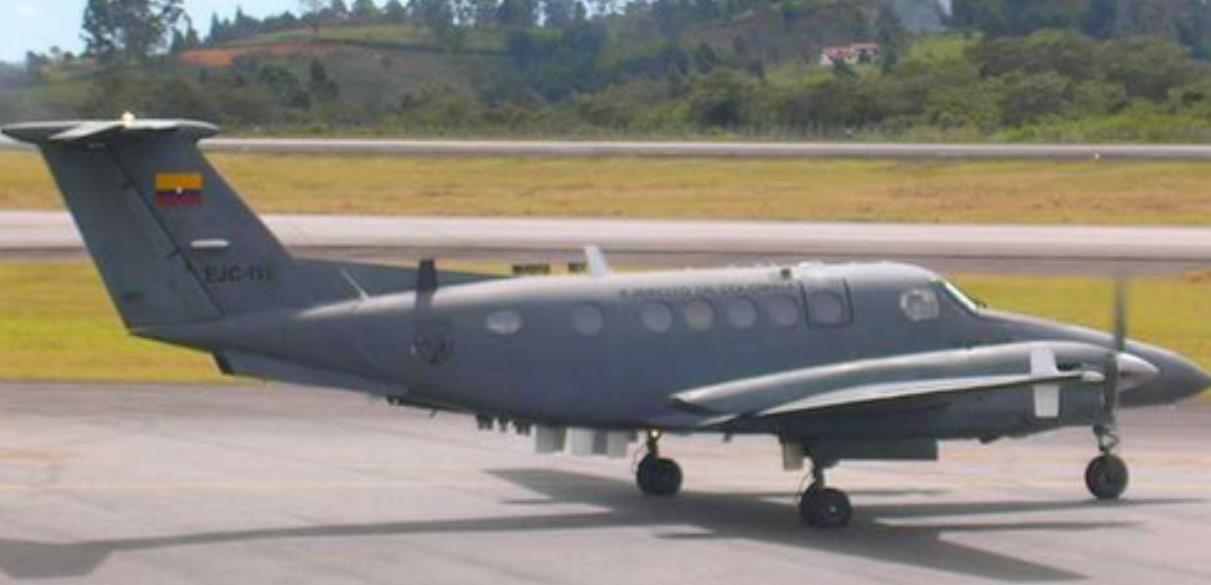
Navy Aviation roundel and fin flash (1953–)
 image by
Nozomi Kariyasu, 7 May 2024
Based on: image
Army Aviation roundel and fin flash (2005–)
 image by
Nozomi Kariyasu, 7 May 2024
Based on: image and image
Low visibility navy aviation roundel
 image from https://volavi.co/wp-content/uploads/2014/08/2014_Historia_Aviacion_Naval_Colombia_Escarapela_Cucarda_Aviacion_Naval_Colombia.jpg.webp
Based on: image
Low visibility army aviation roundel
 image from
Twitter
Third roundel. Established by Decree No. 289 of February 21,
1927 (1927-1953).
Source:
http://www.fac.mil.co/?idcategoria=7994&facmil_2007=e11b77c1a71e91e26db6ca3aec4ce739
Fourth roundel- 1953-present (above). co^n53low.jpg
Source:
http://www.fac.mil.co/?idcategoria=7996&facmil_2007=e11b77c1a71e91e26db6ca3aec4ce739
Roundels are seen also on the FAC
official website
All of the previously mentioned roundels, its images featured on the website and
the text explanation of them is extracted from the folloiwng book:
"75 Años en los Cielos Patrios", published by Editorial Margabby Ltd., First
edition in 1994, by FAC Lt. Col. (r) Oscar Forero Racines.
E.R., 7 July 2008 and 22 December 2009
Different versions of two roundels appear in this source. They differ from
Željko's existing gifs at
in that the star in the 1927-53
one has 9 rays, not 8, and both have a different division of red/blue in the
inner ring. They should not replace Željko's but supplement them, and should be
labeled "alternate depictions."
Eugene Ipavec, 14 June 2011
The current link for the Air Force's official website and information
on roundels is here:
https://www.fac.mil.co/es/conozcanos/simbolos-fuerza-aerea. It is
also complimented with this official tweet (dated June 26, 2020) where
in a short video, it shows the roundels as well:
https://twitter.com/FuerzaAereaCol/status/1276637800557711360.
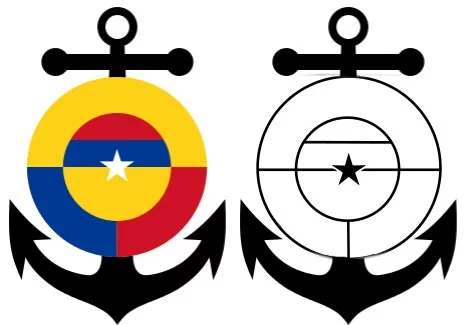
I'd like to mention also the existence of the "5 Colombian Navy
aviation Roundel and fin flash 1953-" (low visibility version) which
follows the same pattern as the image provided by Nozomi ( co^f53 )
but in black outline (as this one.) Furthermore,
there's also the existence of an additional low visibility version in
white outline, in order to match a certain camouflage pattern observed
on several aircraft.
Esteban Rivera, 13 May 2024
 image by Jaume Ollé, 5 November 2001
Fuerza Aerea Colombiana uses a thiner vertion of the
national flag as its fin flash.
Source: B. C Wheeler, An Illustrated Guide to Aircraft
Marking (1986) [whe86].
Dov Gutterman , 8 October 1999
 image located by Esteban Rivera, 13 May 2024
 image located by Esteban Rivera, 13 May 2024
1. Black and white photocopy of "Manual de Pintura FAC
/ Boletín Técnico 1-1-4C" (FAC Painting Manual / Service
Bulletin 1-1-4C), October 1977. This image was obtained by Eduardo
Fadul.
2. Color composition and construction sheet for the
National Cockade as per "Manual de Pintura FAC / Boletín Técnico
1-1-4C" (English: FAC Painting Manual / Service Bulletin 1-1-4C),
October 1977). This image was created by Eduardo Fadul.
Esteban Rivera, 13 May 2024
Looking through my files, I found something related to this very same
topic, Colombia roundels, that I had pending to send. In this case,
the information was located on October 19, 2022 on several Facebook
websites but it's dated years earlier than that. All of this was
compiled by Eduardo Fadul
as well as IPMS (International Plastic Modelers Society) Bogotá.
They deal with the "Cucarda Nacional" (National Cockade), the
colors, dimensions and construction sheet.
Esteban Rivera, 13 May 2024